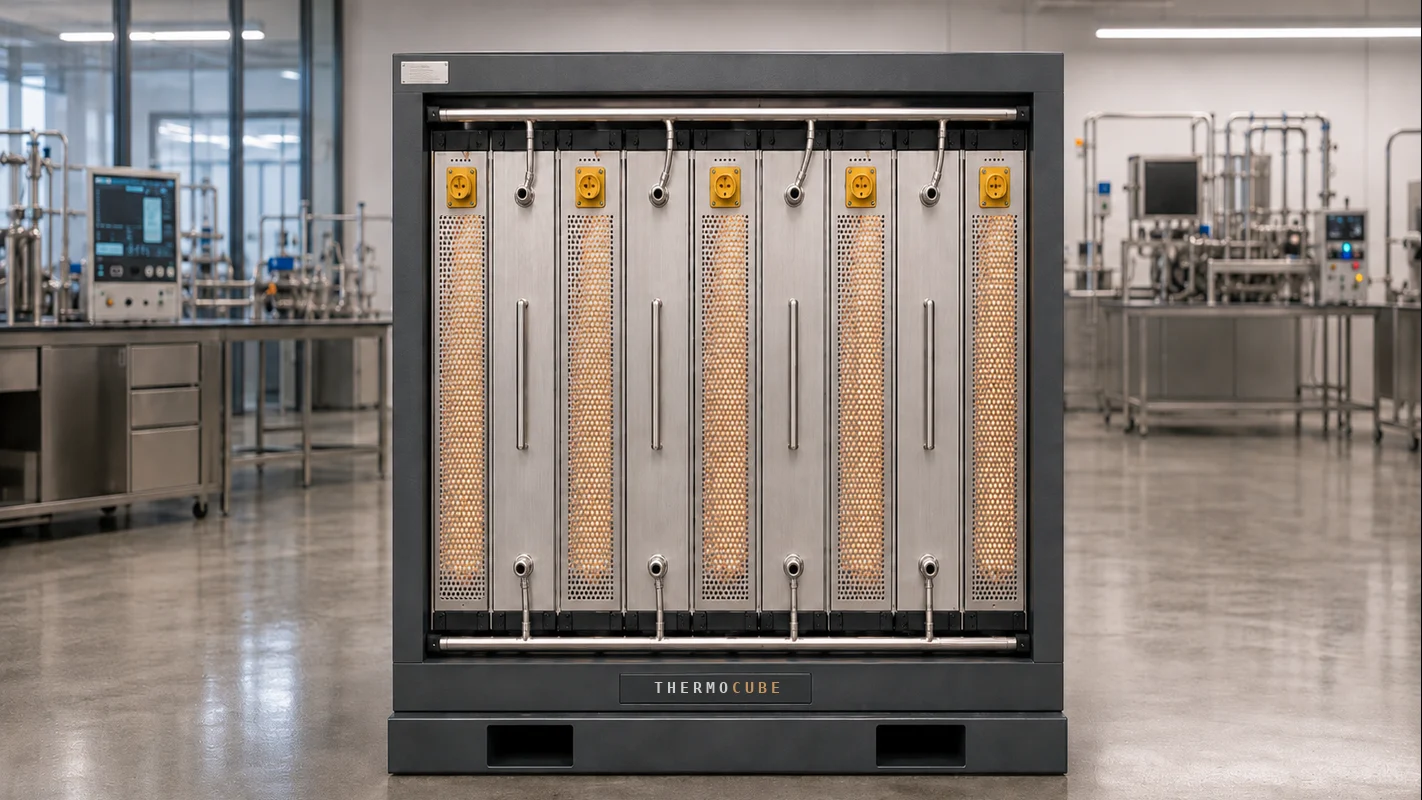
AI-generated concept rendering — single 200 kW module with front-face service plane. Product design in development.
Thermocube is a standardized 200 kW electric heating module for plants that run on electric process heat. Ship from stock, scale by adding cubes, and let the controller manage the elements.
AI-generated concept rendering — single 200 kW module with front-face service plane. Product design in development.
Thermocube replaces custom-engineered heaters with a standardized module. Inside each cube, alternating element and tube cassettes stand vertically side by side and slide out from the front face — all connections accessible from a single service plane.
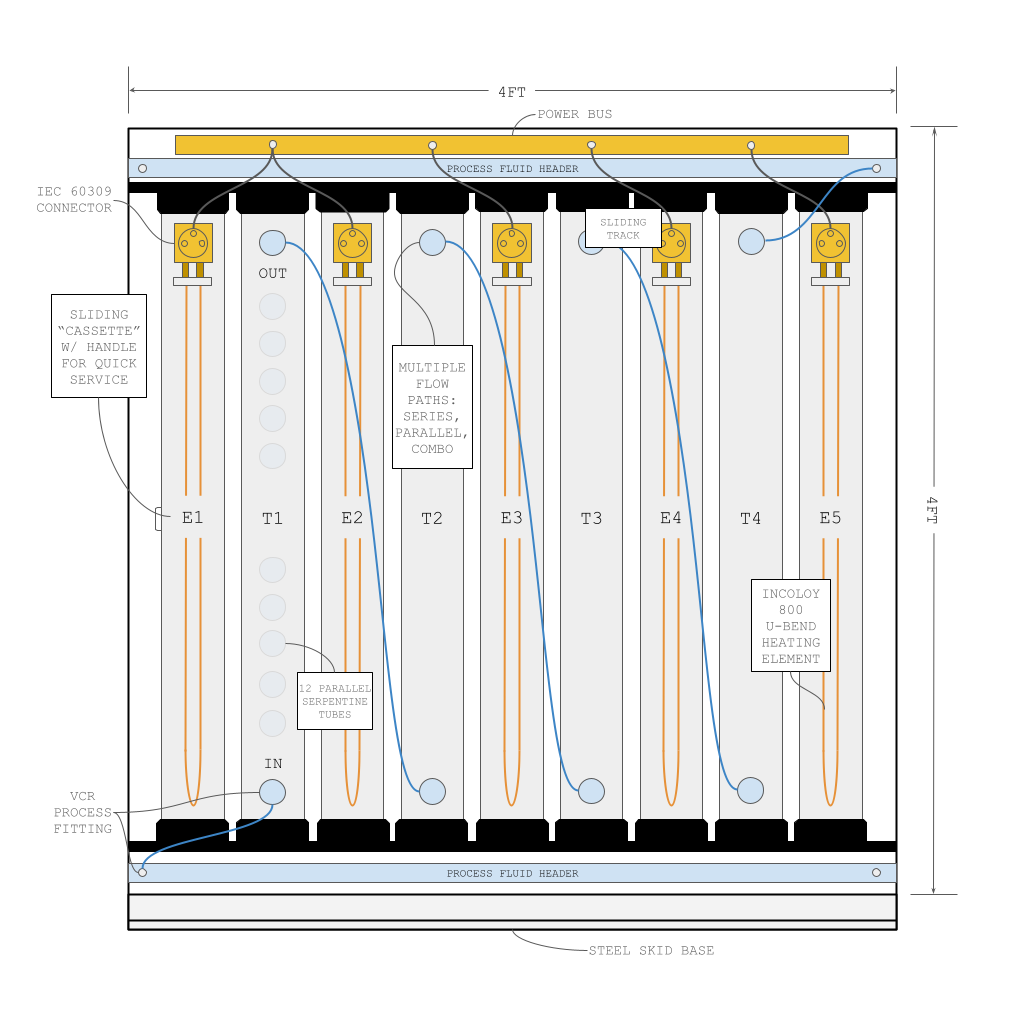
Front-face architecture — 9 vertical cassettes (E1–E5 element, T1–T4 tube) with front-access power and process connections.
Each 4 ft cube delivers up to 200 kW of process heat. Scale by adding modules — 3 cubes for 600 kW, a 2×2 stack for 800 kW, and larger arrays into the MW range.
Five heating element cassettes and four process tube cassettes, alternating. Each slides out independently for service — without draining the system or pulling a bundle.
Switch between parallel, series, or hybrid flow circuits by replumbing front-face fittings. Factory-configured per fluid; changeable in the field.
Five element cassettes per cube, each on its own SCR, with skin thermocouples on every tube cassette. That gives the controller something a single-bundle heater never has: the ability to decide where the heat goes, and to see each element on its own.
Power is shaped along the flow path — lower where the fluid is hottest, the way a well-designed fired heater grades its flux. An immersion heater runs one watt density everywhere.
The controller limits tube surface temperature, not element temperature. Your thermal fluid never sees a surface above its film limit — including at turndown.
When an element's resistance trends toward failure, the controller sheds it and redistributes duty. The cube keeps running at reduced capacity while you schedule the swap. One bad element no longer trips the heater.
Per-element resistance trending, fouling detection from the element-to-fluid ΔT, fluid-life tracking from film-temperature history, and per-cube energy metering for batch costing and emissions reporting. Modbus, Profibus, EtherNet/IP.
Control functions describe design intent for first pilot units.
Configured, not engineered. One module, one set of drawings, one spares list — at every scale from a single cube to a 1 MW array.
Pre-wired, pre-insulated, factory-tested modules from stock. Commission in days — not the 16-plus week custom cycle.
SCR modulation per cassette, ±0.5°C at steady state, and fieldbus integration for recipes, interlocks, and logging.
No fuel gas piping, burner management, or combustion permitting. Where the plant already runs electric heat, there is nothing new to permit.
Element health, fouling index, fluid-life tracking, and energy per cube — on the fieldbus you already run.
Every cassette slides out of the front face. Swap an element or tube cassette during a planned partial-load window — without draining or pulling a bundle.
Compared with the electric heaters it replaces. Fired heaters are a different conversation: where natural gas is available, fuel cost usually wins — and we say so in the FAQ.
| Thermocube | Circulation Heater | Flanged Immersion | Custom Electric Skid | |
|---|---|---|---|---|
| Scale by adding units | ✓ | ✗ | ✗ | ✗ |
| Keeps running after an element fails | ✓ | ✗ | ✗ | Partial |
| Per-element monitoring | ✓ | ✗ | ✗ | Limited |
| Flux profiling / film-temp control | ✓ | ✗ | ✗ | Limited |
| Energy data per unit | ✓ | Limited | ✗ | Limited |
| Service without draining | ✓ | Optional | Optional | Partial |
| Reconfigurable flow circuit | ✓ | ✗ | ✗ | ✗ |
| Lead time | Weeks | 4–12 wks | 8–16 wks | 16–40 wks |
| Commissioning | Days | 1–2 weeks | 1–2 weeks | Weeks to months |
We're pre-commercial and recruiting a small group of process and reliability engineers to critique the design before first builds. Participants get the one-page technical summary now, the aggregated findings later, and first access to pilot units.
No newsletter. Every signup gets a reply.